

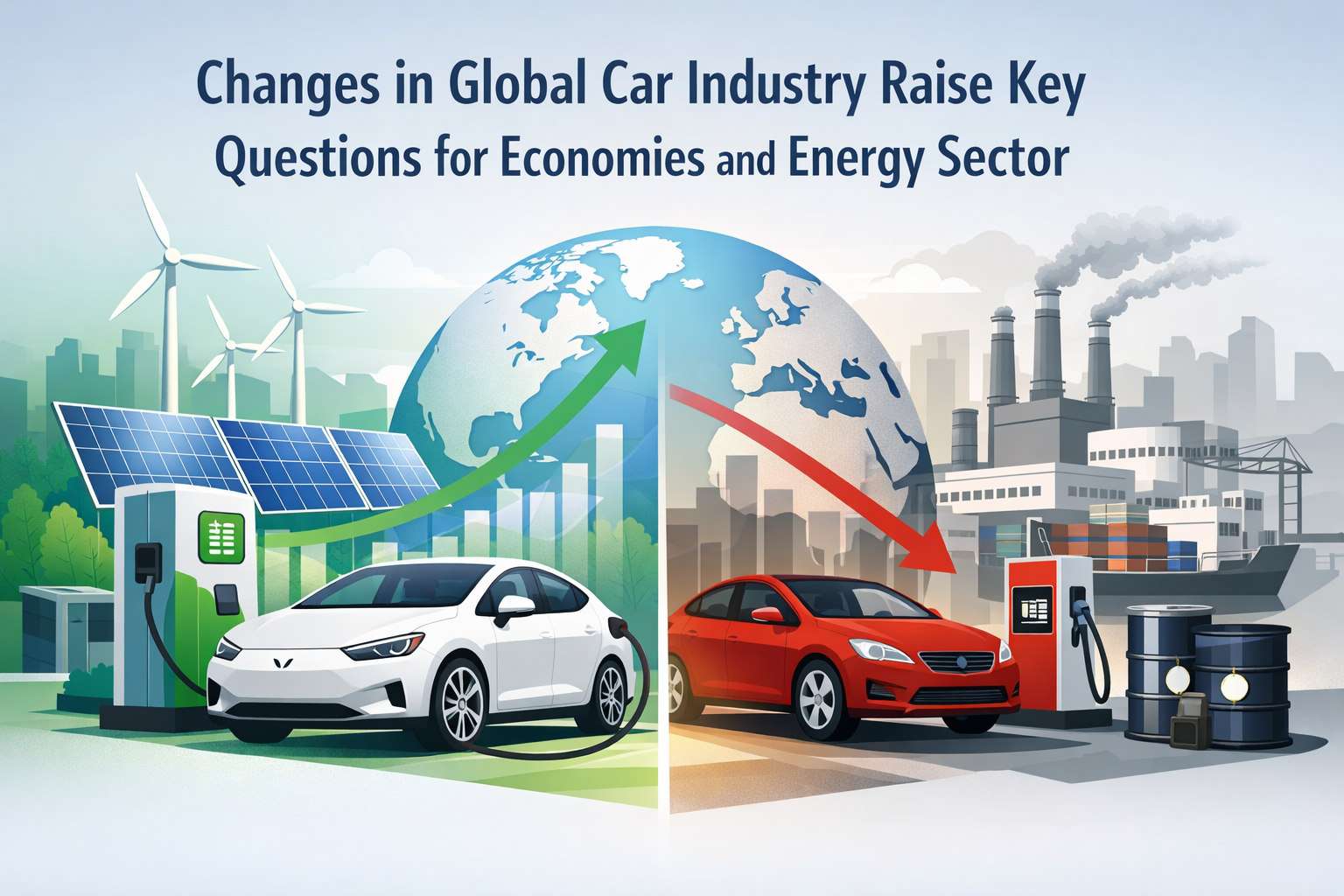
The global automotive industry stands at a crossroads in 2026, facing unprecedented transformations that ripple through economies and energy markets worldwide. The global car industry is currently undergoing major changes that have significant implications for economies around the world and for the energy sector. Three structural shifts are underway in terms of the geography of production, in terms of the regions that are driving sales growth, and in terms of the technologies that car buyers are choosing.
- The Current State of Global Automotive Production in 2026
- Electric Vehicle Market Transformation
- Trade Wars and Tariff Implications
- The Trump Administration’s Trade Policies
- China’s Strategic Response to Western Tariffs
- European Union’s Balancing Act
- Manufacturing Cost Advantages and Global Competition
- Supply Chain Vulnerabilities and Semiconductor Challenges
- The Energy Sector Transformation
- Technological Innovation and Digital Transformation
- Market Trends and Consumer Behavior
- Strategic Implications for Automakers
- Economic and Policy Implications
- Future Outlook and Strategic Considerations
- Navigating Unprecedented Change
The market for cars is one of the largest for a single product, and cars are the single largest source of global oil demand today, with the global car industry directly employing more than 10 million people worldwide and supporting millions of additional jobs. As we navigate through 2026, these fundamental shifts challenge established automotive powerhouses while creating opportunities for emerging markets and new technologies.
The Current State of Global Automotive Production in 2026
Production Forecasts and Regional Dynamics
The global auto industry enters 2026 with a blend of resilience and ongoing challenges, as light vehicle production is forecast to decline modestly. Three themes dominate the landscape: shifting US tariffs and trade policies, China’s robust auto sector both domestically and internationally, and evolving battery electric vehicle (BEV) demand, especially in Europe and North America.
Global light vehicle production is set to edge lower in 2026, squeezed by US automotive tariffs and trade policy uncertainty, China’s expanding automotive footprint and uneven demand for battery electric vehicles (BEVs) in Europe. This production decline represents a significant shift from the steady growth trajectory the industry maintained before recent disruptions.
North America’s 2026 light vehicle production forecast has been revised downward, reflecting a 0.8% decrease amid evolving market dynamics. North American output is slipping as higher prices and the rollback of Inflation Reduction Act incentives cool consumer appetite, with a pre-tariff buying surge in 2025 pulling demand forward and leaving a weaker market in its wake. These dynamics are influencing broader automotive market trends in vehicle production and regional competitiveness.
China’s Dominance and Market Evolution
China, after a stimulus-fueled surge, is now heading into contraction as incentives fade and tax policies tighten. Europe faces subdued demand and mounting pressure from Chinese imports, weighing on domestic production. Despite these headwinds, China continues to reshape the global automotive landscape through aggressive export strategies and technological advancement.
While China faces near-term demand headwinds, export strength continues to underpin production growth. Nearly half of China’s exports in December 2025 were NEVs, and a prospective EV price agreement with the EU should support continued export flows. Although a quick recovery in domestic demand is unlikely in early 2026, robust export performance is expected to sustain production growth.
Electric Vehicle Market Transformation
Global EV Sales Trajectory
Global EV sales increased 25% in 2024 to 17.8 million units, lifting the EV share of the light vehicle market to 19.9%. Growth was driven by strong momentum in China and accelerating PHEV adoption, while Europe and Northern America saw more moderate expansion. For 2025, EV Volumes forecasts 23.7 million EV sales and a 25.5% market share, supported by resilient demand in China and non-Triad markets, alongside a stabilising outlook in Europe despite ongoing economic and political headwinds.
Looking ahead, EV Volumes are expected to rise to nearly 90 million units globally by 2040, accounting for 27.5% of sales in 2026, 43.2% by 2030, and over 83% by 2040. These projections indicate that while electric vehicles continue to gain market share, the transition pace varies significantly across regions.
Regional EV Market Variations
The United States presents a particularly complex picture for electric vehicle adoption. Cox expects 2026 EV sales to be roughly flat again: 1.3 million units and around 8.5% market share. Early January data shows EV and plugin-hybrid penetration running nearly four percentage points below year-ago levels, with internal combustion vehicles and traditional hybrids absorbing the gains. Both EVs and PHEVs are on track to finish the month below 8% retail share, a notable shift from the nearly 12% combined share recorded last January.
Meanwhile, emerging markets are demonstrating surprising momentum. Growth in emerging markets has turbocharged global EV sales in 2025, with over a quarter of new cars sold being electric. ASEAN emerges as a new leader in EV adoption. Viet Nam has doubled its EV sales share since 2024 to reach close to 40% in 2025, overtaking the UK and the EU for EV sales penetration. Thailand has exceeded 20% EV sales share for the first time so far this year, up from 1% in 2019.
Consumer Concerns and Market Barriers
Respondents in several global markets cited their top concerns as driving range, charging time, lack of public charging infrastructure, and battery-related costs or performance. These persistent concerns continue to shape consumer purchasing decisions and manufacturer strategies.
Data from the 2026 study indicates that demand for battery electric vehicles remains steady but cautious, while the appeal of hybrids continues to strengthen as consumers balance affordability, charging access, and everyday practicality. Respondents in some global markets continue to steer away from all-battery electric vehicles in favor of internal combustion engines and hybrids, which could be due, in part, to lingering affordability concerns.
Trade Wars and Tariff Implications
The Trump Administration’s Trade Policies
President Trump has imposed International Emergency Economic Powers Act (IEEPA) tariffs on US trading partners, including China, Canada, Mexico, and the EU. In addition, he has threatened and imposed Section 232 tariffs on autos, heavy trucks, steel, aluminum, lumber, furniture, semiconductors, pharmaceuticals, and copper, among others. The Trump tariffs amount to an average tax increase per US household of $1,000 in 2025 and $1,300 in 2026.
In 2026, tariffs on Chinese made vehicles and components are influencing everything from pricing to supply chain strategy. 25% Tariffs: These apply to certain EVs, batteries, and electronics sourced from China. These policies have fundamentally altered global automotive trade patterns.
China’s Strategic Response to Western Tariffs
Tariffs don’t necessarily change how much you import or export, but they very much redirect where they are, because it’s not like we have a flat tariff on everybody. Our imports from China are way down. Europe’s imports from China are up a fair amount.
Bloomberg reported that China’s EV exports jumped 87% year-over-year to nearly 200,000 units in November, according to customs data. This was not a one-off spike. It reflected a deliberate pivot away from an overcrowded domestic market toward overseas growth. Automakers faced brutal competition at home. Discounts deepened. Profitability shrank. As a result, exports became a lifeline.
European Union’s Balancing Act
If measuring effectiveness by stemming or even stopping the flow of China-made EVs (which is not a stated goal, but which some observers use as a metric of success), the result is a profound failure. Chinese EV brands doubled their market share in the EU in the last year, in part by quadrupling exports of plug-in hybrids (PHEVs) which circumvent the tariffs. That is happening even as European car exports to China continue to decline.
The European Union imposed extra duties ranging from 17% to over 35% on Chinese battery-electric vehicles after a subsidy investigation. In theory, the move aimed to shield European automakers from low-cost imports. In practice, it created a loophole. The tariffs targeted only fully electric vehicles. Plug-in hybrids faced just the standard 10% import duty. And Chinese brands reacted fast.
Manufacturing Cost Advantages and Global Competition
China’s Production Cost Leadership
The report finds that producing cars in China is cheaper than in advanced economies, especially for electric cars. This is primarily due to factors such as large-scale manufacturing operations and vertical integration. Energy prices and labour costs also contribute, but to a lesser degree.
Lower costs for powertrain components explain nearly 40% of the manufacturing cost difference for producing electric cars in China compared with in advanced economies. Much of this is linked to battery costs: average battery cell prices in China are over 30% lower than in Europe and over 20% lower than in the United States.
However, the gap in battery production costs can be bridged with sufficient time and investments, according to the report. While access to low-cost components and critical minerals account for 30% of the cost difference, another 50% is due to manufacturing efficiency and automation.
Localization Strategies and Manufacturing Shifts
Trial production is expected in early 2026, with mass manufacturing planned shortly after. The facility will initially focus on compact models designed for European buyers. Some Chinese firms are moving to local production in the EU, with a BYD facility in Hungary set for trial production in early 2026.
Chinese EV makers have announced several planned investments and production lines in the EU since the tariffs: BYD is modestly expanding an electric bus plant in Hungary, XPENG is licensing production of several models in Austria, and Chery invested in a large research and development (R&D) center attached to its existing investment in Spain.
Supply Chain Vulnerabilities and Semiconductor Challenges

The Looming Semiconductor Crisis
As we approach 2026, the automotive industry is bracing for yet another potential crisis: a shortage of dynamic random access memory (DRAM) chips. This anticipated shortage will not be quite as dramatic as the 2021 crisis which prevented more than 10 million cars from being built that year but could potentially be more disruptive and long-lasting than the 2025 Nexperia incident. DRAM is found in the compute-heavy systems in cars, namely in cockpit and in ADAS/Autonomy systems. However, major DRAM manufacturers are increasingly reallocating their wafer capacity toward high-bandwidth memory (HBM) for AI data centers. The profitability and demand for HBM far exceed those of traditional automotive applications, leaving automakers increasingly vulnerable to an automotive supply chain crunch that could rival the previous shortages.
A supply chain executive at Li Auto issued an even starker alert: the supply fulfillment rate for automotive memory chips could fall below 50% in 2026. Authorities like Wells Fargo, UBS, and S&P Global have issued a cascade of warnings, noting that global automakers could face severe production disruptions and surging costs as early as 2026.
Strategic Responses to Supply Chain Disruptions
In 2026 and 2027, DRAM capacity will be constrained but elastic. If automotive clients are ready to pay more to match the wafer value DRAM makers would get from other industries, then they will get the volume they need. While the additional chip cost is eroding the margin of OEMs, car makers will be able to stomach it as we saw with higher cost increase triggered by US tariffs in 2026.
To manage risks and secure supplies, the automotive industry must take several steps: Stay focused on building resilient supply chains by, for example, considering geopolitical risks when making long-term supply decisions. Shape the future by establishing your place in semiconductor value chains to support your critical supply needs including building the right win-win partnerships with chip makers and developing clear, robust fact bases and analyses to help inform policymakers of the full impact of their decisions.
The Energy Sector Transformation
Impact on Oil Demand
It finds that while global car sales approached 80 million in 2024 having largely bounced back from their pandemic-induced slump the recent growth has been exclusively driven by sales of electric and hybrid cars, which made up around 30% of total sales in 2024. Meanwhile, global sales of pure internal combustion engine (ICE) cars have fallen by 30% since reaching a high in 2017.
The shift toward electrification fundamentally challenges the energy sector’s traditional business models. As electric vehicles capture increasing market share, oil companies face declining demand for gasoline and diesel, forcing strategic pivots toward renewable energy and electric charging infrastructure.
Charging Infrastructure Development
Electrification continues to drive the auto industry forward, but the charging infrastructure is still playing catch-up. That’s why carmakers and their partners are investing money and effort not just in the cars, but in the entire experience. They’re teaming up on smarter navigation that actually locates working chargers, seamless plug-and-charge payments, and even battery technology that speeds up charging at the plug. The next big leap in vehicle tech isn’t only about stretching range. It’s about making charging feel as reliable and straightforward as filling up at the pump used to.
California, Texas, and Florida continue expanding fast-charging corridors, allowing electric ownership to feel less restrictive and more routine. Industry projections place EV market share near twelve percent of new U.S. vehicle sales during 2026.
Technological Innovation and Digital Transformation

Software Defined Vehicles
The transition to software-defined vehicles (SDVs) is revolutionizing the automotive industry by decoupling software from hardware and enabling rapid, ongoing development.
Discover 2026 automotive market trends shaping OEM and supplier strategy, from trade shocks and EVs to AI, software and supply chains. Electrification slows amid challenges in the battery materials supply chain. Automotive digital transformation becomes a revenue engine.
Advanced Materials and Manufacturing Innovation
Chassis technology is undergoing a quiet but consequential shift, as by-wire systems steer-by-wire and brake-by-wire controlled electronically gain ground in premium vehicles such as the Tesla Cybertruck and Mercedes-Benz EQS. Electro-mechanical brakes are slated to debut in North America and China in 2026, with wider adoption expected by 2028. Although established suppliers still dominate, Chinese competitors are rapidly closing the gap, particularly in Europe.
At the same time, materials innovation is reshaping vehicle design, pushing the industry toward lighter, safer and more sustainable platforms. Hot-stamped and ultra-high-strength steels are enabling greater component integration and meaningful weight reduction. Chinese firms are emerging as leaders in magnesium thixomolding, which offers new manufacturing flexibility, while carbon-fiber composites continue to gain traction, supported by advances in bio-based materials and resins that improve both performance and sustainability.
Market Trends and Consumer Behavior
The Rise of Hybrid Vehicles
Here are five of the top trends experts said are likely to shape the industry in 2026. U.S. automakers Ford Motor Co. and General Motors rely on the sales of full-size trucks and SUVs for a majority of their revenue. These vehicles are also widely popular with consumers and that’s not likely to change in 2026. With the Trump administration planning to roll back corporate average fuel economy standards, automakers can continue to churn out these larger models to meet demand and maintain profits in 2026. I think the OEMs are going to address and better balance their powertrains. The CAFE standards are going to allow them to do that, it allows them to focus on customer preference.
With the higher costs of EVs, internal combustion powered vehicles will continue to be a more affordable option for many car buyers and automakers are likely to invest to boost production.
Regional Market Developments
For 2026, S&P Global Mobility now expects a reasonably robust automotive sales gain to 2.92 million units driven largely by CO2 compliance targets that limit attractive internal combustion engine (ICE) offerings. Including commercial vehicles, we project total automotive sales to reach 3.2 million units, up from 3.1 million in 2025.
We expect modest 2026 improvement, driven by ongoing recovery from earlier disruptions, government investment, proactive fiscal measures and the extension of eco-car tax breaks alongside gasoline and diesel fuel subsidy programs.
Strategic Implications for Automakers
Adaptation Strategies
OEMs and suppliers must navigate trade shifts, invest in digital and material innovation and mitigate automotive supply chain challenges particularly in semiconductor shortage and rare earths sourcing. Those who pair electrification ambitions with flexible, targeted strategies as Toyota has are best positioned to outperform in an increasingly volatile market.
The current climate has prompted some automakers to re-evaluate their mid-to-long-term product planning to meet evolving customer demand, while simultaneously working to maintain their profits.
Investment Priorities
South Asia’s production forecast has been raised for 2026-2028, led by India’s robust demand outlook following reductions in the Goods and Services Tax (GST) for various vehicle sizes. Automakers are adjusting production schedules to maximize opportunities from this demand surge.
Japan’s production outlook for 2026-2028 has been lifted due to increased domestic demand from tax reductions and the abolition of the environmental performance tax, as well as the reallocation of Mazda CX-30 production. Long-term gains are also anticipated from strong ICE variant sales in the US and Suzuki’s EV exports to Europe.
Economic and Policy Implications
Government Interventions and Industrial Policy
Scaling back Europe’s EV ambitions: In 2022, the EU effectively instituted an internal combustion engine ban by implementing progressively stricter fleet emission targets, compelling manufacturers to elevate the proportion of EVs or incur penalties. Nonetheless, confronted with the considerable expenses associated with the EV transition and the surge in Chinese competition, certain segments of the European automotive industry and conservative parties across Europe have voiced opposition to the target. A review of the 2035 target, slated for 2026, presents an opportunity to recalibrate objectives, potentially buying ICE-focused European incumbents time and curbing the competitiveness of Chinese EV producers.
Economic Impact Assessment
December global light-vehicle sales are estimated to have decreased 2.4% year over year to 8.4 million units, dragged down by declines in China and North America. The selling rate for December was estimated at 93.0 million units, down from 94.6 million units in November. For 2025 overall, sales are estimated at 91.9 million units, up 3.6% year over year. Our initial forecast for total global sales in 2026 stands at 93.7 million units, up 1.9% year over year. China should still see year over year growth, but at a slower rate than in 2025, as changes to the scrappage incentive scheme are set to discourage OEMs from engaging in a price war.
Future Outlook and Strategic Considerations
Medium Term Projections
It suggests that by 2030, the global electric vehicle stock (excluding two/three-wheelers) will reach nearly 245 million vehicles and grows to 525 million in 2035, when one in four vehicles on the road would be electric. Sales share could reach over 50% in 2035.
Despite rapid sales growth, fleet electrification is progressing slowly. Based on current assumptions, EV Volumes estimates that electric vehicles will only make up around half of the global light vehicle fleet in the early 2040s.
Critical Success Factors
As global OEMs and suppliers navigate shifting tariffs and accelerate supply chain realignment, one truth is clear: there’s no one-size-fits-all strategy to combat this. Now localization is more important than ever. In this automotive industry outlook, experts from China, Japan, Germany, and the United States four of the most influential automotive markets share their unique insights and perspectives on the challenges and trends facing OEMs in 2026. With deep, on-the-ground intelligence, they provide strategic foresight to help you understand how each market thinks, competes and differentiates themselves.
Long Term Structural Changes
Automotive executives must recognize that semiconductor supply challenges, while evolving, are here to stay. The winners will understand their areas of greatest need, assess supply constraints, capitalize on new technologies, and manage geopolitical uncertainty to solve their most crucial supply issues.
Looking ahead to 2026, it’s not enough just to keep up with new trends; you must scale them in a way that actually works and generates revenue.
Navigating Unprecedented Change
The global automotive industry in 2026 finds itself at an inflection point unprecedented in its century long history. The convergence of electrification, trade tensions, supply chain vulnerabilities, and shifting consumer preferences creates both existential challenges and transformative opportunities. Traditional automotive powerhouses must adapt rapidly to maintain relevance, while emerging markets and new entrants capitalize on technological discontinuities to capture market share.
The global automotive industry is moving through one of the most transformative periods in its history. While innovation across the value chain continues to accelerate, the industry’s center of gravity remains the consumer whose expectations around value, access, and experience are changing. Consumers are becoming more value-driven, seeking fairness, trust, and transparency alongside quality and innovation.
The implications extend far beyond corporate boardrooms and factory floors. National economies dependent on automotive manufacturing face fundamental restructuring. Energy markets must pivot from petroleum dominance to electricity infrastructure. Supply chains require unprecedented resilience and diversification. Most critically, the industry must balance environmental imperatives with economic realities, technological possibilities with consumer acceptance, and global integration with geopolitical fragmentation.
Success in this environment demands strategic agility, technological innovation, and deep understanding of rapidly evolving market dynamics. Companies that can navigate these complexities while maintaining operational excellence and financial discipline will emerge as tomorrow’s industry leaders. Those unable to adapt face marginalization or extinction.
As we move forward, the automotive industry’s transformation will continue accelerating, driven by technological innovation, regulatory pressure, and changing consumer expectations. The winners will be those who embrace change, invest strategically, and maintain flexibility in an increasingly uncertain world. The global car industry’s evolution represents not just a sectoral transformation but a fundamental reshaping of how societies move, economies function, and energy systems operate. Understanding and adapting to these changes remains critical for stakeholders across the automotive value chain and beyond.