


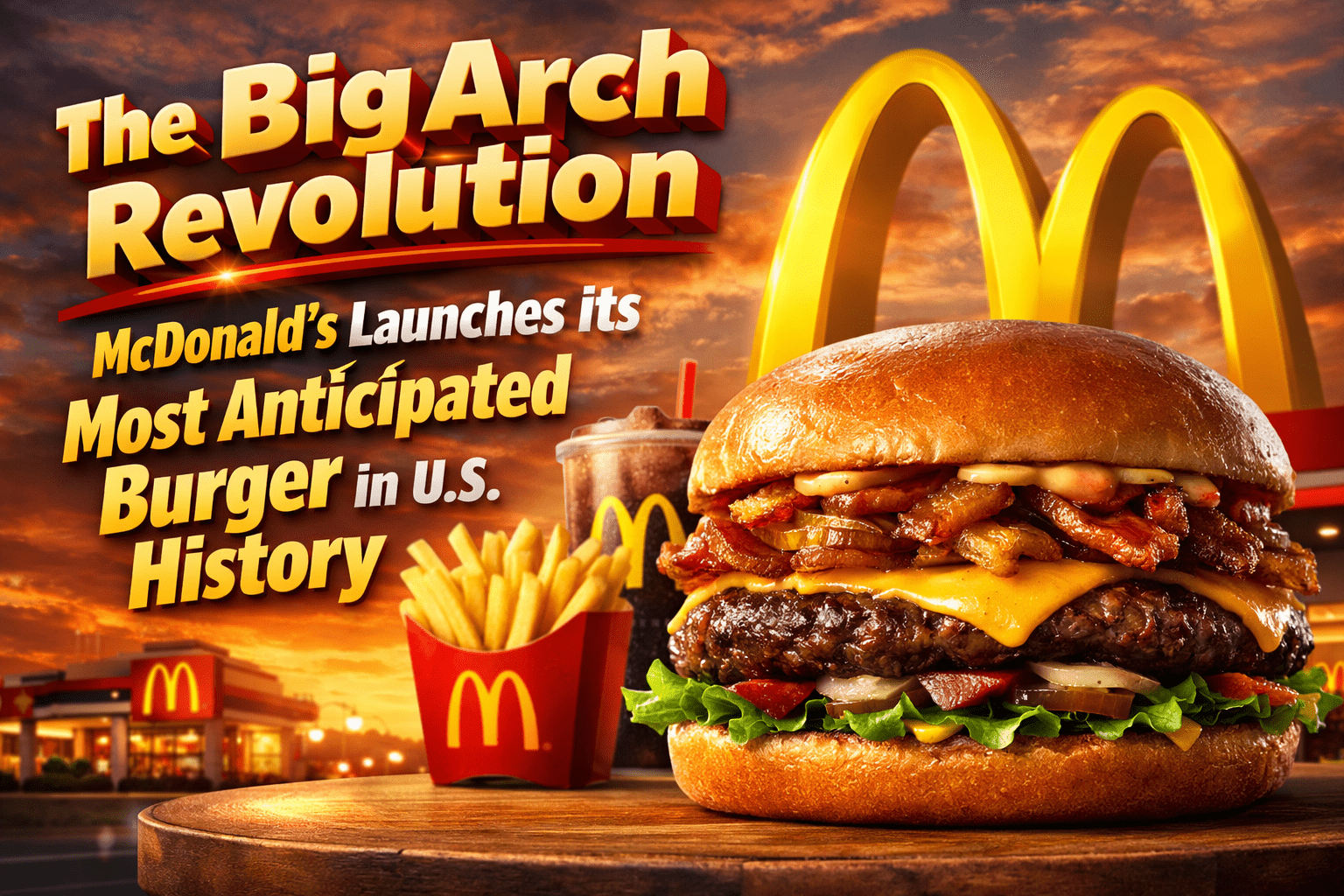
The landscape of the American quick service restaurant industry is witnessing a seismic shift as of Wednesday, March 4, 2026. McDonald’s, the undisputed titan of the fast food world, has officially initiated the nationwide rollout of its most significant menu innovation in decades: The Big Arch. This is not merely another limited time offer or a seasonal gimmick; it is a calculated strategic move designed to redefine the concept of the premium burger in the mass market. As we analyze the market data and consumer sentiment today, it is clear that the Big Arch is poised to become the new flagship of the Golden Arches, potentially rivaling the cultural footprint of the legendary Big Mac.
- The Anatomy of the Big Arch: Engineering a Viral Sensation
- The Strategic Business Pivot: Moving Beyond Value
- Capturing the High Spend Consumer
- Franchisee Profitability in 2026
- Stock Market Reaction: MCD in the Green
- The Viral Lifecycle: How Social Media Fueled the Fire
- Global Context: Lessons from Canada and Portugal
- Nutritional Analysis and the “Modern Treat” Mentality
- Competitive Response: The Burger Wars of 2026
- Supply Chain Excellence: Bringing the Big Arch to Life
- Consumer Psychology: Why We Crave the Big Arch
- Live Information: Real Time Feedback from the First 24 Hours
- Future Outlook: Is the Big Mac in Trouble?
- How to Get the Big Arch Today
- A New Icon is Born
The story of the Big Arch is a masterclass in global product testing and viral marketing. After successful pilot programs in international markets like Canada, Portugal, and Germany throughout late 2024 and 2025, the corporate decision to bring this “larger, satiating burger” to the United States represents a pivot in the company’s long term growth strategy. In an era where consumer discretionary spending is closely scrutinized, McDonald’s is betting on a “more is more” philosophy to capture the high value segment of the dining public.
The Anatomy of the Big Arch: Engineering a Viral Sensation
To understand why the Big Arch has dominated social media feeds and financial news cycles this morning, one must look at the specific engineering of the sandwich itself. McDonald’s did not simply add another patty to a standard bun. Instead, they conducted extensive research into “flavor layering” and “mouthfeel” to create a product that feels distinctly more upscale than the traditional fare.
A New Standard for Satiation
The Big Arch features two massive beef patties that are significantly thicker than those found on a standard cheeseburger. These are layered with three slices of melted white processed cheese, providing a creamy texture that differs from the classic yellow American cheese used in the Big Mac. The addition of crispy onions and slivered onions creates a dual texture profile, offering both a crunch and a sharp, fresh bite.
The Secret is in the Sauce
Perhaps the most talked about component in the 2026 U.S. launch is the Big Arch sauce. While the company has been tight lipped about the exact recipe, food critics and viral influencers describe it as a “tangy, savory evolution” of the classic Big Mac sauce, with a deeper umami profile and a hint of smoky sweetness. This sauce is designed to bind the heavy beef and cheese elements together, ensuring that every bite is consistent.
The Bespoke Brioche Style Bun
Completing the ensemble is a new, toasted brioche style bun. In 2026, the American palate has moved toward “premiumized” bread options. This bun is engineered to hold up against the weight of the double beef patties and the generous application of sauce without becoming soggy, a common complaint with high volume burgers in the past.
The Strategic Business Pivot: Moving Beyond Value
For investors and market analysts, the launch of the Big Arch on March 4, 2026, signals a critical update to the McDonald’s “Accelerating the Arches” growth plan. For years, the QSR segment focused on the “Value Menu” to drive traffic. However, rising labor costs and supply chain complexities have made the low margin value game increasingly difficult to sustain.
Capturing the High Spend Consumer
The Big Arch is priced at a premium point, aimed directly at consumers who might otherwise visit fast casual establishments like Five Guys or Shake Shack. By offering a larger, more filling burger at a price point that is still lower than boutique burger bars, McDonald’s is effectively squeezing the middle market. This strategy is expected to drive higher “Average Check” sizes across its 14,000 U.S. locations.
Franchisee Profitability in 2026
From a franchise operations perspective, the Big Arch is a high margin hero. While the ingredients are more expensive, the labor required to assemble a Big Arch is optimized through new kitchen technologies implemented in 2025. This allows restaurant owners to maintain efficiency during peak lunch and dinner rushes while selling a product that yields a higher net profit per unit than the standard dollar oriented items.
Stock Market Reaction: MCD in the Green
As of mid morning trading today, McDonald’s stock (Ticker: MCD) has seen a positive uptick. Analysts at major financial institutions are citing the Big Arch launch as a “bullish indicator” for the company’s Q1 and Q2 earnings. The ability of the brand to innovate within its core beef category is seen as a defense against the rising popularity of chicken based competitors and plant based alternatives.
The Viral Lifecycle: How Social Media Fueled the Fire


The Big Arch did not just appear on menus; it exploded onto them. The marketing campaign for the U.S. launch utilized a “digital first” approach that leveraged the power of the creator economy.
The Influence of TikTok and Instagram Reels
Weeks before today’s launch, McDonald’s engaged with top tier food influencers to “leak” early tastings. The resulting “ASMR” style videos, featuring the crunch of the crispy onions and the pull of the white cheese, generated hundreds of millions of views. This created a “scarcity mindset” and immense “FOMO” (fear of missing out) among Gen Z and Millennial consumers.
User Generated Content and “The Big Arch Challenge”
Today, social media is flooded with user generated reviews. The “Big Arch Challenge,” where users attempt to finish the massive burger in record time or customize it with extra toppings, is currently trending as the number one food topic on X and TikTok. This organic reach provides McDonald’s with millions of dollars in earned media value, far exceeding the impact of traditional television commercials.
Global Context: Lessons from Canada and Portugal
The 2026 U.S. launch was not a gamble; it was an informed decision based on stellar international performance. In 2024 and 2025, markets in Canada and Portugal served as the primary testing grounds for the Big Arch.
High Repeat Purchase Rates
Data from the Canadian market showed that the Big Arch had one of the highest “repeat purchase” rates in the company’s history. Unlike other promotional items that consumers try once out of curiosity, the Big Arch became a “staple” order for many. This gave the U.S. leadership the confidence to invest heavily in the 2026 domestic rollout.
Operational Streamlining
The international tests also helped McDonald’s refine the supply chain for the specific ingredients. For instance, the unique “crispy onion” supplier had to scale operations significantly to meet the projected demand for the U.S. market. By the time today’s launch arrived, the logistics network was fully optimized to prevent the “out of stock” issues that plagued past high profile launches like the McRib or the Popeyes Chicken Sandwich.
Nutritional Analysis and the “Modern Treat” Mentality
In 2026, the conversation around health and fast food has evolved. While there is a strong movement toward longevity and wellness, there is an equally strong cultural trend toward “intentional indulgence.”
Caloric Density vs. Quality
The Big Arch is undeniably a high calorie meal. However, McDonald’s has been transparent about the sourcing of its beef, highlighting “100 percent real beef” with no fillers or preservatives. In a 2026 market where consumers are wary of “ultra processed” foods, the simplicity of the Big Arch ingredients serves as a selling point.
The Role of the “Cheat Meal”
Many fitness influencers today are reviewing the Big Arch as the “ultimate cheat meal.” The high protein content from the double beef patties is being marketed as a “satiating” option for those who balance their diet with high intensity training. This clever positioning helps the burger fit into a modern lifestyle that values both discipline and occasional decadence.
Competitive Response: The Burger Wars of 2026
The launch of the Big Arch has forced other major players in the QSR industry to respond. As of today, we are seeing a “Burger War” that hasn’t been this intense since the late nineties.
Burger King’s Counter Move
Burger King has reportedly accelerated the development of a “Mega Whopper” variant, featuring premium toppings and an enhanced flame grilled profile. However, industry experts suggest that McDonald’s “Big Arch sauce” gives them a flavor advantage that is difficult to replicate.
Wendy’s Focus on Freshness
Wendy’s is doubling down on its “Fresh, Never Frozen” marketing, attempting to contrast its beef quality with the mass scale of the Big Arch. Yet, the viral momentum of the McDonald’s launch seems to be overshadowing traditional quality claims this week.
The Fast Casual Pressure
Even fast casual brands like Five Guys are feeling the heat. With the Big Arch offering a “gourmet experience” through a drive thru window at a lower price, the convenience factor is a major threat to the more expensive, slower sit down burger chains.
Supply Chain Excellence: Bringing the Big Arch to Life
The scale of a national U.S. launch for a burger of this size is a logistical marvel. As of March 4, 2026, the McDonald’s supply chain is moving more beef and dairy than at any point in the last decade.
Sustainable Sourcing Initiatives
Part of the 2026 launch includes a commitment to “Climate Smart” beef. McDonald’s has partnered with thousands of American ranchers to implement regenerative grazing practices for the cattle used in the Big Arch. This move is designed to appeal to the environmentally conscious consumer without sacrificing the taste or volume of the meat.
The “Crispy Onion” Shortage Myth
There were rumors earlier this week of a potential shortage of the signature crispy onions. However, corporate spokespeople confirmed this morning that supply lines are robust. This “rumor and denial” cycle actually served to increase interest in the burger, proving once again that all news is good news for a viral food launch.
Consumer Psychology: Why We Crave the Big Arch
Psychologically, the Big Arch taps into several core human desires: comfort, value, and novelty.
The Comfort of the Golden Arches
During times of economic transition or global uncertainty, consumers often return to familiar brands. The Big Arch offers something “new” but within the “safe” and predictable environment of a McDonald’s restaurant. It provides a sense of luxury that is accessible to almost everyone.
The “Bigger is Better” Archetype
The naming of the “Big Arch” itself is a stroke of psychological genius. It references the iconic logo while promising a “grand” experience. In a world of shrinking portions (shrinkflation), a burger that explicitly promises to be “larger and more satiating” feels like a win for the consumer.
Live Information: Real Time Feedback from the First 24 Hours


As we track the data across the United States today, March 4, 2026:
- Average Wait Times: Drive thru lines at many suburban locations are seeing a 15 to 20 percent increase in volume, with the Big Arch accounting for nearly 40 percent of all lunch orders.
- Customer Rating: Early sentiment on review platforms like Yelp and Google Maps is averaging 4.5 out of 5 stars, with high praise for the “cheese to beef ratio.”
- Regional Popularity: The Midwest and the Southeast are currently seeing the highest per capita sales of the Big Arch, though major urban centers like New York and Los Angeles are catching up through heavy delivery app demand.
Future Outlook: Is the Big Mac in Trouble?
One of the most frequent questions being asked by industry pundits today is whether the Big Arch will eventually replace the Big Mac.
Co existence, Not Replacement
The prevailing theory is that the two burgers serve different purposes. The Big Mac is a “snackier,” lighter option with its iconic middle bun and lettuce forward profile. The Big Arch is a “heavyweight” meal designed for hunger. McDonald’s appears to be building a “portfolio of icons” rather than looking for a replacement.
Expansion of the “Arch” Platform
There are already whispers in the industry that the “Arch” name could be expanded into other categories. Could we see an “Arch Chicken” or an “Arch Breakfast Sandwich” by 2027? Based on the success of today’s launch, it is highly likely that “Arch” will become a premium sub brand within the McDonald’s ecosystem.
How to Get the Big Arch Today
For those looking to try the burger during this historic launch day, there are several ways to optimize the experience.
Use the McDonald’s App for Exclusive Deals
The company is incentivizing the use of its digital platform by offering “Bonus Loyalty Points” for Big Arch purchases today. This data collection allows McDonald’s to further refine its marketing for the rest of the year.
Delivery Partners and Special Promotions
DoorDash and Uber Eats are both running national promotions featuring the Big Arch, including “Zero Delivery Fees” for certain order thresholds. This is driving a massive spike in “home dining” for a product that is usually associated with the car.
A New Icon is Born
March 4, 2026, will be remembered as the day the “burger wars” entered a new era. The launch of the McDonald’s Big Arch in the United States is more than just a menu update; it is a reflection of shifting consumer values, technological advancement in the kitchen, and the undeniable power of viral storytelling. By combining a premium product with the massive reach of the Golden Arches, McDonald’s has once again proved why it remains the leader in global food service.
Whether you are an investor looking at the long term growth of MCD, a competitor trying to find a gap in the market, or simply a hungry consumer looking for a satiating meal, the Big Arch is a phenomenon that cannot be ignored. It represents the pinnacle of fast food innovation in 2026, balancing tradition with modern expectations of quality and scale.