

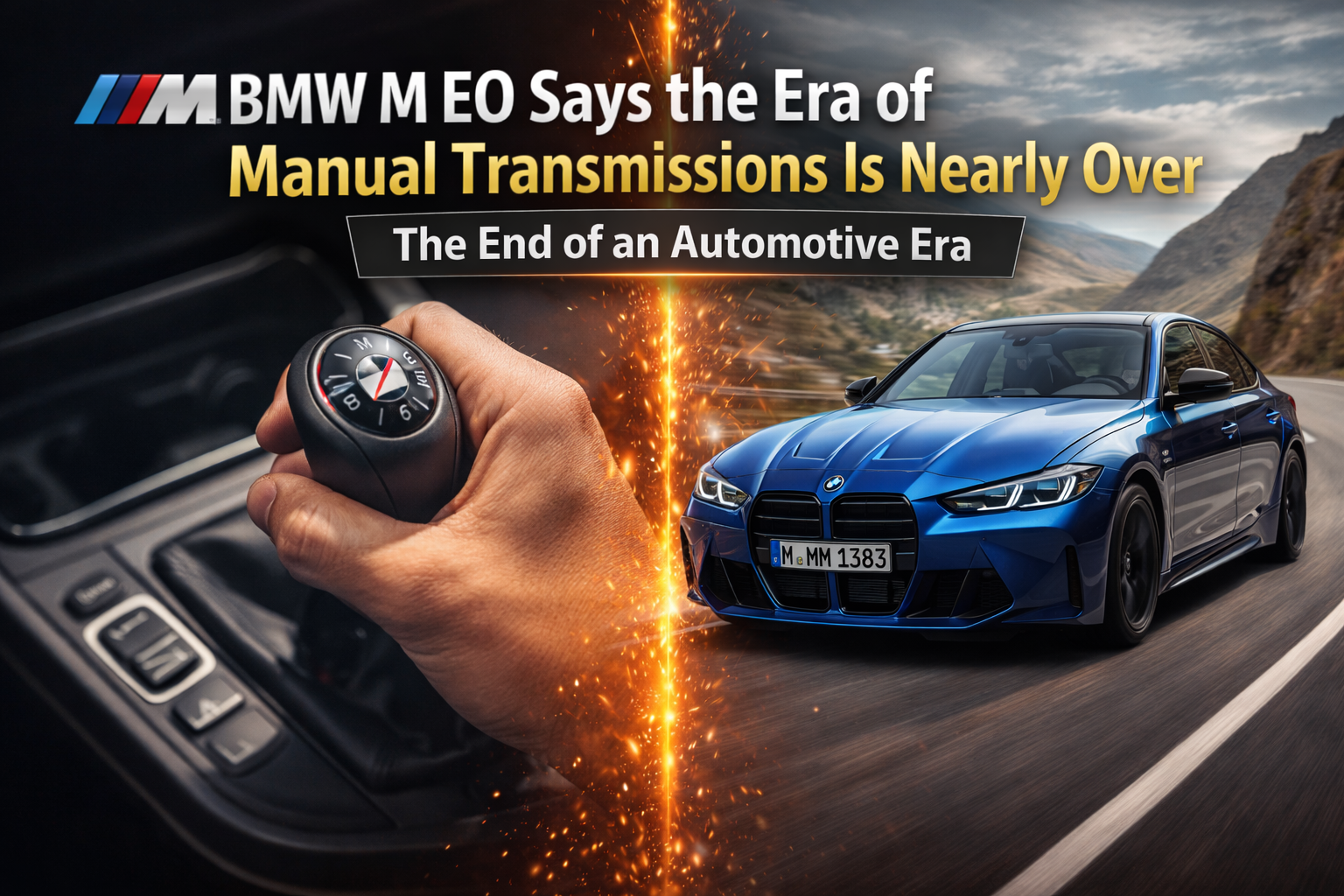
The automotive world received sobering news that confirms what enthusiasts have long feared: the manual transmission, that beloved third pedal that has defined driving engagement for generations, is approaching its final chapter. The BMW M boss says the era of manual transmissions is nearly over and has confirmed that the M2 and M4 are nearing their production end. This announcement marks a pivotal moment in automotive history, signaling the definitive transition from traditional driver engagement to electrified performance.
- The BMW M Announcement: What Was Said
- Understanding the Regulatory Pressure
- The Current State of Manual Transmissions
- Why Enthusiasts Love Manual Transmissions
- The Industry Response
- The Economics of Manual Transmissions
- The Technology Argument
- Electric Vehicles and the Future of Transmissions
- What This Means for Enthusiasts
- The Final Analysis: What We Lose
- The Industry at a Crossroads
- Looking Ahead: What Replaces the Manual Experience
- The Collector Market Impact
- Global Implications
- Preserving the Manual Experience
- The End of an Era
For decades, the manual gearbox has been the hallmark of pure driving experiences, connecting drivers to their machines in ways that automatic transmissions simply could not replicate. The satisfying click of engaging a gear, the precise timing of clutch and throttle coordination, and the complete control over the powertrain have defined what it means to be an enthusiast driver. However, as regulatory pressures mount and electrification accelerates, even the most devoted performance brands are acknowledging an uncomfortable truth.
This comprehensive guide explores the implications of BMW M’s announcement, examining the current state of manual transmissions in the automotive industry, the market forces driving this change, and what the future holds for driving enthusiasts who have long cherished the art of rowing their own gears.
The BMW M Announcement: What Was Said
Frank van Meel’s Statement
During the 2025 Pebble Beach Concours d’Elegance, BMW M CEO Frank van Meel delivered the definitive word on the future of manual transmissions in the M lineup. The BMW M boss says the era of manual transmissions is nearly over, and that forthcoming regulations will effectively prohibit cars equipped with manual transmissions.
BMW M CEO Frank van Meel told Motor Trend at the Pebble Beach Concours d’Elegance that the M2 and M4 will be the last M cars to offer the transmission configuration: “I think in general the era of the manual transmission is coming to an end,” van Meel told Motor Trend. “First of all, regulations in the EU get harder and harder with different regulations, and this leads to a point where you cannot offer a manual any more. Forget about the era of manual transmissions.”
The Regulatory Reality
The statement carries significant weight because it addresses not just consumer preferences but the regulatory framework that will make manual transmissions effectively impossible to offer. BMW M CEO Frank van Meel confirmed with Motor Trend that the M2 and M4 will be the last M models to feature a manual transmission, not because of declining interest, but largely due to increasingly strict emissions regulations.
It was Frank van Meel, the boss of BMW M, who recently mentioned that regulations being implemented in the European Union will likely spell the end of manual transmissions in their vehicles. While this doesn’t mean all manual-transmission vehicles are going away tomorrow, given such statements from an industry leader, the trend seems clear: manuals are on the way out.
The Last Manual M Cars
The confirmation specifically identified the M2 and M4 as the final guardians of the manual transmission tradition at BMW M. The current models remain among the last holdouts, with van Meel indicating that owners who need to shift to the next gear will soon find themselves out of luck.
Understanding the Regulatory Pressure
European Union Requirements
The regulatory landscape in Europe has become increasingly hostile to traditional internal combustion powertrains, and manual transmissions face unique challenges in this environment. Upcoming EU7 emissions regulations require near-instantaneous adaptation to driving conditions, something that manual transmissions fundamentally cannot provide with the same precision as automated systems.
EU7, the next set of European emission standards, will require the vehicle to react immediately to every input by the driver, which would necessitate features like predictive shift patterns and automated clutch engagement that are incompatible with traditional manual operation.
The Emissions Challenge
The issue extends beyond simple tailpipe emissions. Modern vehicles must constantly optimize their powertrain operation to minimize emissions across all driving conditions. Automated transmissions, whether dual-clutch systems or traditional torque converters, can be programmed to shift at precisely the right moment for optimal efficiency and emissions performance. Manual transmissions, by definition, rely on human input, introducing variability that makes compliance with stringent regulations increasingly difficult.
Timeline Considerations
While van Meel did not provide specific dates, the current generation of M2 and M4 models represents the last opportunity for enthusiasts to purchase a new BMW M car with a manual gearbox. Given typical model cycles, this suggests the manual transmission will disappear from the M lineup entirely within the next few years.
The Current State of Manual Transmissions
Declining Sales Numbers
The manual transmission has been on a steady decline for years, with current statistics painting a stark picture of consumer preferences. Manual transmissions, which were the majority, have seen a steady decline over the years, now representing only 0.9% of the total market. Sales of manual transmissions in the US peaked in the 1990s and have declined precipitously since. In 2024, manual transmissions represented just 0.9% of the total new car market, down from 1.2% in 2023.
The numbers tell a compelling story of a technology being abandoned by the mainstream market. Manual transmissions were available in only 74 models in the US in 2024, down from 80 models in 2023, 96 models in 2022, and 153 models in 2018. This represents a more than 50% reduction in availability over just six years.
The Sports Car Exception
Despite the overall decline, manual transmissions have found their strongest remaining market in sports cars and performance vehicles. The Subaru BRZ/Toyota GR86, Ford Bronco, Ford Mustang, Mazda MX-5 Miata, and Porsche 911 led the US manual transmission car sales in 2024, accounting for over half of all manual cars sold in the US in 2024.
However, even this stronghold shows signs of weakening. With manual transmissions declining, automakers such as Ferrari, Lamborghini, and others now only offer automated transmissions or dual clutches.
Global Perspective
The situation varies by region, with manual transmissions maintaining stronger positions in some markets. While 66% of cars in India still have a manual gearbox, European markets have seen dramatic shifts. Just 10 years ago, the market share of manual gearboxes in Europe was 80%, versus 20% for automatics. Today, that number has dropped to 51.3%, according to Jato Dynamics data.
Why Enthusiasts Love Manual Transmissions
The Connection to the Machine
For driving enthusiasts, the manual transmission represents far more than a method of changing gears. It embodies a direct, unfiltered connection between driver and machine that automated systems cannot replicate. The physical act of moving the shift lever, coordinating clutch and throttle, and timing shifts perfectly creates an intimate bond with the vehicle.
The Skill Factor
Manual transmission driving requires a learned skill that many enthusiasts take pride in mastering. The ability to execute perfect heel-toe downshifts, rev-match seamlessly, and launch the car without stalling represents achievements that distinguish skilled drivers from mere transportation users.
The Anti-Theft Benefit
There is a peculiar phenomenon where manual transmissions in the United States serve as an effective anti-theft device. With fewer than 20% of Americans knowing how to drive a manual transmission, many potential car thieves simply cannot operate vehicles equipped with a clutch pedal. However, with theft protection technology advancing and the number of manual transmission drivers likely declining, this advantage is diminishing.
The Industry Response
Other Manufacturers Following Suit
BMW is not alone in its assessment. Across the industry, manufacturers are reaching similar conclusions about the viability of manual transmissions. Audi had 12 models with available manual transmissions ten years ago. Today, they have only one. Mazda, traditionally a strong supporter of manual transmissions, offers them in only seven of its vehicles across 2024-2025 models.
Porsche’s Commitment
Not all premium manufacturers have abandoned the cause. Manual transmission enthusiasts concerned over the future of three-pedal sports cars have reason for hope, or at least reassurance, following Porsche’s announcement that it plans to continue to develop the manual gearbox for future models.
Thomas Friemuth, who heads Porsche’s GT vehicle development, said that the manual gearbox is safe for the foreseeable future in the marque’s lineup. “For the GT cars, there is no substitute to manual transmission.” While this may not represent a permanent stance, it provides some comfort to enthusiasts.
Toyota’s Position
Toyota has maintained its commitment to manual transmissions in certain vehicles. Toyota’s Executive VP, Jack Hollis, announced last year that Toyota will continue to offer stick shifts in their lineup for as long as there is market demand. This commitment has been demonstrated through vehicles like the GR Corolla and GR86, which have found enthusiastic buyers.
The Economics of Manual Transmissions
Development Costs
One factor rarely discussed in the manual transmission debate is the economics of maintaining parallel development programs. Automakers must invest significant resources in developing, testing, and certifying manual transmission options that represent an increasingly tiny fraction of sales. As volumes decline, the cost per unit rises, creating a negative feedback loop.
Production Complexity
Offering manual transmissions adds complexity to production lines that are increasingly optimized for efficiency. Assembly plants must maintain tooling, training, and inventory for transmission options that may represent single-digit percentages of production.
Resale Value Considerations
Interestingly, manual transmissions have shown remarkable resilience in the used car market, often commanding premiums over automatic-equipped equivalents in enthusiast vehicles. This suggests that while new car buyers may prefer automatics, the secondary market still values the manual option.
The Technology Argument
Modern Automatics Outperform
From a pure performance standpoint, modern automated transmissions have surpassed manual gearboxes in virtually every measurable metric. Dual-clutch transmissions can shift faster than any human, automated systems can be programmed for optimal efficiency, and torque converter automatics have become remarkably refined.
Porsche’s PDK dual-clutch transmission, BMW’s M Steptronic, and similar systems offer shift speeds measured in milliseconds, something physically impossible with a traditional manual linkage. For drivers focused purely on lap times or acceleration, the case for manual transmissions becomes increasingly difficult to make.
The Counterargument
However, performance enthusiasts note that the joy of driving is not captured in spreadsheet metrics. The engagement, satisfaction, and connection provided by a manual transmission cannot be quantified in shift times or fuel economy figures. This philosophical divide between measurable performance and subjective driving experience lies at the heart of the manual transmission debate.
Electric Vehicles and the Future of Transmissions
EVs Eliminate the Need
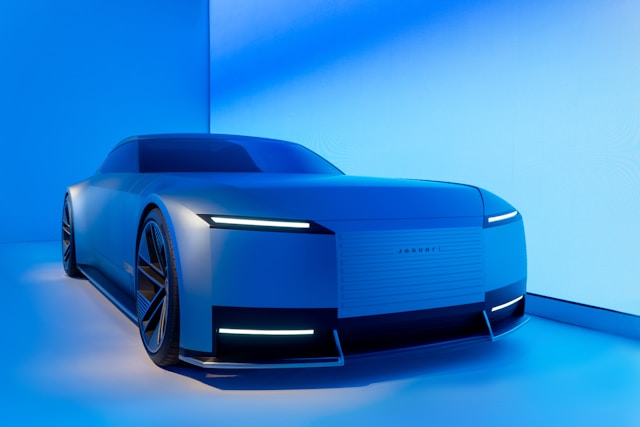
The transition to electric vehicles fundamentally changes the transmission discussion. Electric motors produce maximum torque from zero RPM and can operate efficiently across a broad speed range, eliminating the need for multi-speed transmissions entirely. Most electric vehicles use single-speed reduction gears, making the manual versus automatic debate irrelevant.
The Hybrid Challenge
Hybrid vehicles present unique challenges for manual transmissions. The complex interplay between internal combustion engines and electric motors requires precise control that is difficult to achieve with manual operation. While some hybrid vehicles have offered manual transmissions, the integration challenges have led most manufacturers to standardize on automated options.
BMW’s Electric M Future
BMW has committed to offering electrified versions of its entire M lineup, including fully electric models. The recently announced concepts suggest that BMW M will focus on delivering engagement through other means, including torque vectoring systems, adaptive suspensions, and regenerative braking calibration, rather than transmission selection.
What This Means for Enthusiasts
Buy Now or Miss Out
For enthusiasts who value manual transmissions, the message is clear: the window to purchase a new manual transmission vehicle is closing. Current M2 and M4 models represent the last opportunity to buy a new BMW M car with three pedals, and similar situations exist across much of the industry.
The Used Market
As manual transmission availability declines in new vehicles, the used market for manual-equipped performance cars may become increasingly robust. Enthusiasts seeking the manual experience may need to look to pre-owned vehicles to satisfy their preferences.
Preservation Culture
A growing community of enthusiasts has emerged around preserving manual transmission vehicles. Collector interest in manual-equipped sports cars has strengthened, with well-maintained examples commanding significant premiums.
The Final Analysis: What We Lose
More Than a Transmission
When the last manual transmission rolls off the production line, we lose more than a mechanical component. We lose a direct connection to automotive history, a skill that defined generations of drivers, and a choice that represented the last bastion of driver control in an increasingly automated world.
The Engagement Factor
Modern vehicles excel at transporting occupants efficiently and safely, but they increasingly isolate drivers from the driving experience. The manual transmission was one of the last elements requiring active driver participation, demanding attention and rewarding skill.
Cultural Significance
The manual transmission carries cultural weight beyond its mechanical function. Learning to drive stick was once a rite of passage, a skill handed down through generations. As this transmission type fades, so too does a shared experience that connected driving enthusiasts across decades.
The Industry at a Crossroads
The Electrification Push
The automotive industry’s aggressive push toward electrification has created a timeline that makes the manual transmission’s demise inevitable. Major manufacturers have announced plans to phase out internal combustion engines entirely within the next 10-15 years. In this context, investing in manual transmission development makes little business sense.
Regulatory Certainty
The regulatory trajectory is clear, even if specific implementation dates vary. Emissions standards will continue to tighten, and the flexibility that manual transmissions require from drivers creates inherent variability that conflicts with these requirements.
Consumer Acceptance
Perhaps the most telling indicator is consumer behavior. Despite vocal enthusiasm communities, actual buying patterns strongly favor automatic transmissions. When given the choice, the overwhelming majority of buyers, even performance car buyers, select automatics.
Looking Ahead: What Replaces the Manual Experience
Simulated Engagement
Some manufacturers have experimented with simulated shift experiences in automatic vehicles, providing manual modes with paddle shifters and rev-matching features. While these systems offer some level of engagement, purists note they lack the physical connection of a true manual.
New Performance Metrics
As transmissions become irrelevant in electric vehicles, performance focus will shift to other areas. Torque vectoring, adaptive dynamics, and regenerative braking calibration may become the new battlegrounds for driving engagement.
The Analog Revival
Interestingly, some manufacturers have explored reviving analog elements in modern vehicles. The success of vehicles like the Toyota GR86 and Mazda MX-5 suggests a market segment values simplicity and driver connection over raw performance metrics.
The Collector Market Impact
Rising Values
Classic cars equipped with manual transmissions have shown strong value appreciation, a trend likely to accelerate as new manual vehicles become unavailable. Enthusiast vehicles from the golden age of manual transmissions may become increasingly desirable collectibles.
Future Classics
Current manual transmission vehicles may represent the last generation to offer this driving experience new. Models like the BMW M2, Porsche 911 GT3, and Mazda MX-5 with manual transmissions could become highly sought-after collector vehicles in coming decades.
Investment Potential
For those considering vehicles as investments, manual transmission sports cars from the current era may offer appreciation potential as the supply of drivable manual vehicles inevitably declines over time.
Global Implications
Regional Differences
The fate of manual transmissions will vary by region. Developing markets where manual transmissions remain dominant may see continued availability longer than North American or European markets. However, as global vehicle platforms become increasingly standardized, regional variations may become economically unsustainable.
Emerging Market Shift
India, the largest remaining market for manual transmissions, is also seeing rapid growth in automatic adoption. As infrastructure improves and consumers become more affluent, the preference shift toward automatics appears universal.
The Chinese Factor
China, the world’s largest automotive market, has shown strong preference for automatic transmissions from the outset of mass motorization. This market force has influenced global product planning significantly.
Preserving the Manual Experience
Driving Schools and Experiences
As manual transmission vehicles become rarer in everyday life, driving schools and track day experiences that feature manual vehicles may grow in popularity. These programs offer opportunities to learn and practice skills that would otherwise be impossible to develop.
Simulator Technology
Advanced driving simulators now offer remarkably realistic manual transmission experiences. While not a substitute for the real thing, these systems may help preserve the knowledge and appreciation of manual driving for future generations.
Enthusiast Communities
Online and in-person enthusiast communities centered around manual transmission vehicles continue to thrive. These groups provide resources for maintenance, modification, and appreciation of manual vehicles.
The End of an Era
The announcement from BMW M’s Frank van Meel confirms what industry observers have long anticipated: the manual transmission is living on borrowed time. The combination of regulatory pressure, consumer preferences, and the industry’s transition to electrification has created an environment where the traditional three-pedal setup simply cannot survive.
For enthusiasts, this moment demands acknowledgment of what we stand to lose. The manual transmission represented more than a mechanical system; it embodied a philosophy of driving engagement, a connection between human and machine that defined the automotive experience for over a century.
Yet the industry moves forward. The vehicles of tomorrow will offer new forms of engagement, new technologies to explore, and new ways to experience the joy of driving. Whether these innovations can match the visceral satisfaction of a perfectly executed heel-toe downshift remains to be seen.
What is certain is that the manual transmission, once the only way to drive, will soon join carburetors, crank starters, and bias-ply tires in the museum of automotive history. For those who cherish the manual driving experience, the time to act is now. The last manual M cars are rolling off production lines, and when they stop, an era ends.
The gearshift, that simple lever that connected generations of drivers to their machines, deserves recognition as it takes its final bows. It changed the way we thought about driving, defined performance motoring for decades, and gave enthusiasts a reason to choose engagement over convenience. Its passing marks not just a technological transition but the closing of a chapter in automotive culture that can never be reopened.