

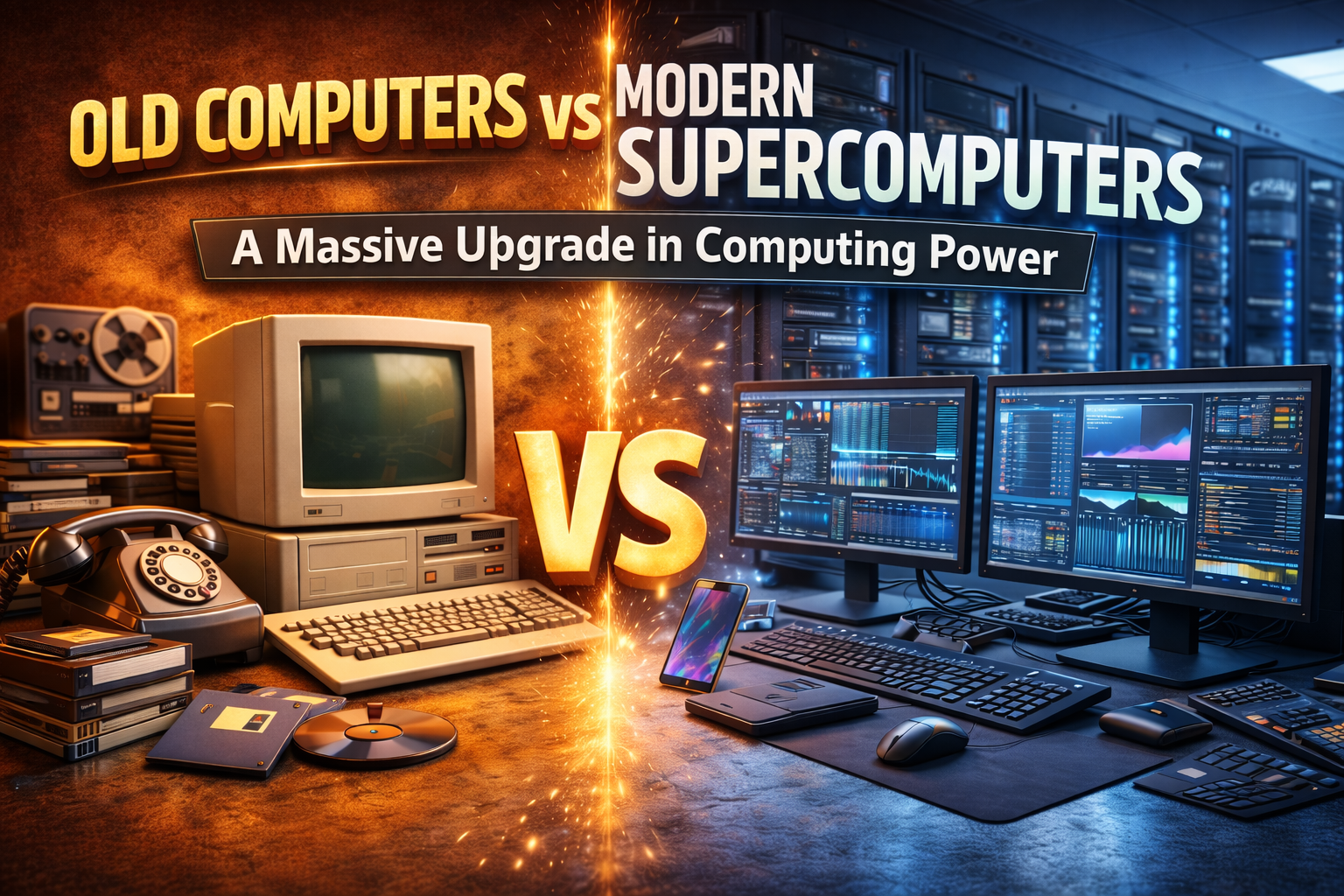
The journey of computing represents one of humanity’s most remarkable technological achievements. ENIAC chewed through 150kW, weighed 30 tons, and used up 1,800 sq ft, but its compute performance is laughable compared even to a smart toothbrush processor today. This staggering comparison captures the essence of how far computing technology has advanced in less than a century. The journey from those clunky, power-hungry machines to the mind-boggling performance of modern supercomputers and AI accelerators is awe-inspiring. While the ENIAC could perform a mere 5,000 operations per second, an iPhone 16 can zip through 35 trillion instructions per second, while AI accelerators like NVIDIA’s GH200 or the AMD EPYC 9000 series boast capabilities in the exascale range, performing quintillions of operations every second.
- The Dawn of Electronic Computing: ENIAC and Its Era
- The Birth of the First Electronic Computer
- ENIAC’s Physical Specifications
- ENIAC’s Computing Capabilities
- The Reliability Challenge
- The Evolution of Supercomputing: Key Milestones
- Modern Supercomputers: The Exascale Era
- The Staggering Comparison: Old vs. New
- Performance Improvements Over Generations
- Consumer Devices vs. Early Supercomputers
- Smartphones Surpassing Historical Supercomputers
- The Vacuum Tube Comparison
- The Technology Behind the Transformation
- Moore’s Law: The Driving Force
- The Future of Moore’s Law
- The Rise of Heterogeneous Computing
- The Operating System Revolution
- What Modern Supercomputers Can Do
- The Global Supercomputing Race
- Energy Efficiency and Green Computing
- The Democratization of Computing Power
- The Future of Supercomputing
- The Practical Impact on Society
- Understanding Performance Metrics
- The TOP500 List: Tracking Progress
- From Giant Brain to Quantum Leap
This comprehensive guide explores the extraordinary evolution of computing power, from the earliest electronic computers to today’s exascale supercomputers. We will examine the technological breakthroughs, the remarkable comparisons between generations, and what the future holds for high performance computing in 2026 and beyond.
The Dawn of Electronic Computing: ENIAC and Its Era
The Birth of the First Electronic Computer
ENIAC was formally dedicated at the University of Pennsylvania on February 15, 1946, having cost $487,000 (equivalent to $7,000,000 in 2024), and called a “Giant Brain” by the press. It had a speed on the order of one thousand times faster than that of electro-mechanical machines. The Electronic Numerical Integrator and Computer (ENIAC) holds a legendary place in the history of computing. Completing development in 1945 at the University of Pennsylvania, ENIAC was the first general-purpose, programmable electronic computer. It revolutionized technology and paved the way for modern computing.
ENIAC’s Physical Specifications
In terms of its physical presence and build, an ENIAC Top Trumps card might be an ace. It featured 8,000 vacuum tubes, 70,000 resistors, 10,000 capacitors, and 500,000 soldered joints, with dedicated power lines delivering 150kW of electricity. Naturally, ENIAC was huge and heavy, too. The Penn Engineering blog says that it occupied a 30 x 50 foot room and weighed 30 tons. The ENIAC contained 17,468 vacuum tubes, 7,200 crystal diodes, 1,500 relays, 70,000 resistors, and 10,000 capacitors. There were around 5 million hand-soldered joins. The iPhone, like most modern computing devices, runs on integrated circuits probably soldered together by passing the entire motherboard over a pool of molten solder on an automated assembly line.
ENIAC’s Computing Capabilities
While we can no longer marvel at ENIAC’s compute prowess, it was around 1,000x faster than its nearest rivals in the mid 1940s. ENIAC could perform around 5,000 calculations per second, allowing humans to tap into math at electronic speed for the first time. This first general-purpose electronic computer was used to perform a variety of tasks. However, as ENIAC was funded by the U.S. military, some of its best-known compute tasks include calculating artillery trajectories. “The ballistics calculation that previously took 12 hours on a hand calculator could be done in just 30 seconds,” notes the Penn Engineering blog. ENIAC was also used in H-bomb calculations, ballistic missile and rocket calculations, for weather prediction experiments, and more.
The Reliability Challenge
Because of the reliability limitations of vacuum tubes, the longest up-time for the ENIAC (between having to replace at least one of the tubes because of burn outs) was only 116 hours. Can you imagine getting any work done on a modern smart phone or computer if you had to get it repaired every four days?
The Evolution of Supercomputing: Key Milestones
The Birth of the Supercomputer Era
The history of supercomputing goes back to the 1960s when a series of computers at Control Data Corporation (CDC) were designed by Seymour Cray to use innovative designs and parallelism to achieve superior computational peak performance. The CDC 6600, released in 1964, is generally considered the first supercomputer. The CDC 6600 had a computing power of 3 megaflops, a threefold increase in power over the IBM 7030 Stretch. This was the first computer which was ever called a supercomputer. Unlike the IBM 7030 Stretch, it used an integrated circuit as a central processor. The cost at the time was $2,370,000. Adjusted for inflation, it would cost about $24 million dollars today.
The Cray Revolution
In 1975 Cray released the Cray-1 supercomputer. It was a revolutionary new computer and a massive jump in computer power. It had a computing power of 160 megaflops, the first computer to break the 100 megaflop barrier. With every new model of supercomputer, Seymour Cray attempted to get at least a ten fold improvement in computing power. He did just that with the release of the Cray-2 in 1979. The Cray-2 introduced liquid cooling to improve performance, and it had a computing power of 1.9 billion FLOPS or 1.9 GFLOPS. It sold for $16 million dollars at its release, which would be worth almost 70 million dollars today.
Breaking Performance Barriers
It had a computational power of 1.8 trillion FLOPS or 1.8 terraflops, becoming the first supercomputer to break the teraflop barrier. Five years later, in 2002, the NEC corporation in Japan created the Earth Simulator, which had a power of 35 teraflops. Six years later, in 2008, IBM retook the title of the world’s most powerful computer with the IBM Roadrunner. They didn’t just break the 100 teraflop barrier. The Roadrunner had a power of 1,105 trillion flops or 1.1 quadrillion FLOPS, or, to put it most succinctly, 1.1 petaflops. This was also a mesh-based MIMD massively-parallel system with over 9,000 compute nodes and well over 12 terabytes of disk storage, but used off-the-shelf Pentium Pro processors that could be found in everyday personal computers. ASCI Red was the first system ever to break through the 1 teraflop barrier on the MP-Linpack benchmark in 1996; eventually reaching 2 teraflops.
Modern Supercomputers: The Exascale Era
The World’s Fastest Supercomputer: El Capitan
Lawrence Livermore National Laboratory’s exascale El Capitan retained its ranking as the world’s fastest supercomputer with a verified 1.809 exaFLOPs (quintillion calculations per second) on the Top500 organization’s High Performance Linpack benchmark. The El Capitan system at the Lawrence Livermore National Laboratory, California, USA remains the No. 1 system on the TOP500. The HPE Cray EX255a system was remeasured with 1.809 Exaflop/s on the HPL benchmark. LLNL also achieved 17.41 Petaflop/s on the HPCG benchmark which makes the system the No. 1 on this ranking as well. El Capitan has 11,340,000 cores and is based on AMD 4th generation EPYC processors with 24 cores at 1.8 GHz and AMD Instinct MI300A accelerators.
The Exascale Club
With El Capitan, Frontier, and Aurora, there are now 3 Exascale systems leading the TOP500. All three are installed at Department of Energy (DOE) laboratories in the United States. El Capitan leads the rankings at 1.742 exaflops, followed by Frontier at 1.353 exaflops and Aurora at 1.012 exaflops. The United States operates 172 systems with 6,475 petaflops of aggregate performance, while Lenovo manufactures 162 TOP500 supercomputers. The JUPITER Booster system at the EuroHPC / Jülich Supercomputing Centre in Germany at No. 4 submitted a new measurement of 1.000 Exflop/s on the HPL benchmark. It is the fourth Exascale system on the TOP500 and the first one outside of the USA.
Global Supercomputing Rankings
Lawrence Livermore’s El Capitan, an HPE Cray EX255a with AMD 4th Gen Epyc 24C 1.8GHz CPUs and Instinct MI300A GPUs, reported an HPL score of 1.742 exaflops. It is followed by Oak Ridge’s Frontier, an HPE Cray EX235a with AMD 3rd Generation Epyc 64C 2GHz CPUs and Instinct MI250X GPUs. Frontier achieved 1.353 exaflops. Rounding out the top three is another HPE system, this time Argonne’s Cray EX-based Aurora with the Intel Exascale Compute Blade, Xeon CPU Max 9470 52C 2.4GHz, and Intel Data Center GPU Max.Japan comes in at seven, with the Arm-based Fugaku supercomputer, built by Fujitsu for Riken. It achieved 442.01 petaflops. We’re back to Europe for the next three: Switzerland’s Alps (434.9 pflops), Finland’s Lumi (379.7 pflops), and Italy’s Leonardo (241.2 pflops).
The Staggering Comparison: Old vs. New
Performance Improvements Over Generations
Since 1993, performance of the No. 1 ranked position has grown steadily in accordance with Moore’s law, doubling roughly every 14 months. In June 2018, Summit was fastest with an Rpeak of 187.6593 PFLOPS. For comparison, this is over 1,432,513 times faster than the Connection Machine CM-5/1024 (1,024 cores), which was the fastest system in November 1993 (twenty-five years prior) with an Rpeak of 131.0 GFLOPS.Moore’s Law has largely held true into the twenty-first century, though it has begun to slow down as engineers reach the limits of shrinking circuits within the laws of physics. Even so, the computing power of a single integrated circuit today is roughly 2 billion times what it was in 1960.
Consumer Devices vs. Early Supercomputers
The original Intel Pentium computer, released in 1993, had a power of approximately 60 megaflops, depending on configuration. This would have put it on a par with an early 1970s supercomputer, again, at a fraction of the price. The 1997 Pentium II had a power of approximately 350 megaflops, again depending on configuration, and the 1999 Pentium III had a power of 1.3 gigaflops. Once again, there is about a 20-year lag between the Cray-2 and the Pentium III. In the 2000s, Intel began to sell multi-core processors. The 2006 Intel Core 2 Duo could achieve a power of 20 gigaflops. This was twice as powerful as the 1986 ETA-10 supercomputer.
Smartphones Surpassing Historical Supercomputers
It is 1.5″ x 2.5″. It has a couple of computers on it. If compared to the giant ENIAC: It is 1,300X more powerful. Is this the latest iPhone or Droid? NOPE, it is turn-of-the-century, run-of-mill, cell phone with texting, MP3, and 0.3 mega-pixel picture capabilities. It was the stuff of science fiction in the 1940s to think about wearable electronic brains, and who knew that these devices would ever be able offer so many types of inputs and outputs in such a tiny package as the modern smart phone. In the span of just over 60 years to go from a huge machine that could do mere hundreds of calculations a second to one that can do billions of operations per second—while fitting in the palm of your hand—is mind boggling.
The Vacuum Tube Comparison
If you built an iPhone with vacuum tubes instead of transistors, packed together with the same density as they were in UNIVAC, the phone would be about the size of five city blocks when resting on one edge. Conversely, if you built the original UNIVAC out of iPhone-size components, the entire machine would be less than 300 microns tall, small enough to embed inside a single grain of salt.
The Technology Behind the Transformation

Moore’s Law: The Driving Force
Moore’s law observes that the count of transistors in a microchip doubles approximately every two years. This emphasizes the growth and efficiency of computing power over time. This trend has guided the semiconductor industry for many years. Moore’s Law is a techno-economic model that has enabled the information technology industry to double the performance and functionality of digital electronics roughly every 2 years within a fixed cost, power and area. Moore’s Law has profoundly impacted the semiconductor industry. It has driven exponential advancements in technology. This growth shapes many aspects of our lives. Although not a physical law, it has been an accurate observation for over 50 years.
The Future of Moore’s Law
Some forecasters, including Gordon Moore, predicted between 2012–2016 that Moore’s law would end by around 2025. Although Moore’s Law will reach a physical limit, some forecasters in 2019 and 2020 were optimistic about the continuation of technological progress in a variety of other areas, including new chip architectures, quantum computing, and AI and machine learning. Nvidia CEO Jensen Huang declared Moore’s law dead in 2022; several days later, Intel CEO Pat Gelsinger countered with the opposite claim. That sense of certainty and predictability has now gone, and not because innovation has stopped, but because the physical assumptions that once underpinned it no longer hold. So what replaces the old model of automatic speed increases? The answer is not a single breakthrough, but several overlapping strategies. One involves new materials and transistor designs. Engineers are refining how transistors are built to reduce wasted energy and unwanted electrical leakage. These changes deliver smaller, more incremental improvements than in the past, but they help keep power use under control.
The Rise of Heterogeneous Computing
In recent years, heterogeneous computing has dominated the TOP500, mostly using Nvidia’s graphics processing units (GPUs) or Intel’s x86-based Xeon Phi as coprocessors. This is because of better performance per watt ratios and higher absolute performance. AMD GPUs have taken the top 1 and displaced Nvidia in top 10 part of the list.
The Operating System Revolution
Linux powers 100% of the TOP500 most powerful supercomputers worldwide as of November 2024, maintaining complete market dominance for seven consecutive years since November 2017. The open-source operating system controls all 500 ranked systems, including three exascale machines that exceed one exaflop of computing power. El Capitan leads the rankings at 1.742 exaflops, followed by Frontier at 1.353 exaflops and Aurora at 1.012 exaflops. The United States operates 172 systems with 6,475 petaflops of aggregate performance, while Lenovo manufactures 162 TOP500 supercomputers. Linux adoption in supercomputing grew from a single system in 1998 to total market capture within 19 years.
What Modern Supercomputers Can Do
Scientific Discovery and Research
A supercomputer is a type of computer with a high level of performance as compared to a general-purpose computer. Supercomputers play an important role in the field of computational science, and are used for a wide range of computationally intensive tasks in various fields including quantum mechanics, weather forecasting, climate research, oil and gas exploration, molecular modeling (computing the structures and properties of chemical compounds, biological macromolecules, polymers, and crystals), and physical simulations (such as simulations of aerodynamics, of the early moments of the universe, and of nuclear weapons). They have been essential in the field of cryptanalysis. Because they can work with massive amounts of data and process calculations incredibly fast, scientists often use supercomputers to crack problems in drug and material discovery. Supercomputers can also make predictions—like forecasting the weather—and even learn how to play chess, like IBM’s classic Deep Blue supercomputer in 1997.
National Security Applications
Since debuting atop the Top500 list a year ago, El Capitan has consistently pushed the boundaries of scientific discovery, excelling in both advanced modeling and simulation and AI workloads,” said Rob Neely, associate director for Weapon Simulation & Computing at LLNL. “This year, it has elevated our national security mission, serving as a capstone achievement for the ASC program’s exascale goals. El Capitan’s success is a direct result of the dedication and expertise of our facilities, operations and code development teams, working seamlessly alongside our valued partners at HPE and AMD. Together, we have set a new standard for what’s possible in high-performance computing. Built to serve NNSA’s stockpile stewardship mission as a shared resource for LLNL and the Los Alamos and Sandia national laboratories, El Capitan delivers more than 20 times the speed of LLNL’s recently retired Sierra system.
Medical and Scientific Breakthroughs
Now second in the list, Frontier—built by supercomputing giant HPE Cray—became the first exascale computer in the world when it went online in 2022. Scientists initially planned to use Frontier for cancer research, drug discovery, nuclear fusion, exotic materials, designing superefficient engines and modeling stellar explosions, according to IEEE Spectrum. In the coming years, scientists will use Frontier to design new transport and medicine technologies, reported MIT Technology Review. Evan Schneider, assistant professor in computational astrophysics at the University of Pittsburgh, told MIT Tech Review that he wants to run simulations of how the Milky Way has evolved over time.
The Global Supercomputing Race
United States Leadership
The United States reclaimed global leadership from China in TOP500 system count as of June 2023. American facilities operate 172 systems with 6,475,558 gigaflops of aggregate performance, representing 34.4% of all ranked supercomputers. China reduced representation from 80 systems in June 2024 to 62 systems in November 2024 without introducing new machines. Analysts attribute this decline to geopolitical considerations related to U.S. semiconductor export restrictions rather than reduced computing capability. As of submitted data until June 2025, the United States has the highest number of systems with 175 supercomputers; China is in second place with 47, and Germany is third at 41; the United States has by far the highest share of total computing power on the list (48.4%).
European Achievements
North America leads continental rankings with 181 systems, representing 36.2% of TOP500 installations. Europe operates 162 systems at 32.4%, surpassing Asia’s 142 systems in 2024. The EuroHPC Joint Undertaking initiative contributed significantly to European expansion through deployments across Finland, Italy, Spain, and Germany. As of November 2025, the number one supercomputer is El Capitan, the leader on Green500 is KAIROS, a Bull Sequana XH3000 system using the Nvidia Grace Hopper GH200 Superchip. EuroHPC’s JUPITER became Europe’s first system to reach the exascale milestone.
The China Factor
After the onset of US-China Trade War, China has largely shrouded its newly online supercomputers and data centers in secrecy, opting out of reporting to the TOP500 list. This is partly driven by fears of being targeted by US sanctions placed on Chinese domestic suppliers. They are the only publicly disclosed exascale systems—China no longer submits new supercomputers to Top500, but is believed to operate several exascale systems.
Energy Efficiency and Green Computing
The Power Challenge
Aurora is the system with the greatest power consumption with 38,698 kilowatts. Significant progress was made in the first decade of the 21st century. The efficiency of supercomputers continued to increase, but not dramatically so. The Cray C90 used 500 kilowatts of power in 1991, while by 2003 the ASCI Q used 3,000 kW while being 2,000 times faster, increasing the performance per watt 300 fold.
Innovations in Cooling Technology
Heat management is a major issue in complex electronic devices and affects powerful computer systems in various ways. The thermal design power and CPU power dissipation issues in supercomputing surpass those of traditional computer cooling technologies. The supercomputing awards for green computing reflect this issue. The packing of thousands of processors together inevitably generates significant amounts of heat density that need to be dealt with. The Cray-2 was liquid cooled, and used a Fluorinert “cooling waterfall” which was forced through the modules under pressure. However, the submerged liquid cooling approach was not practical for the multi-cabinet systems based on off-the-shelf processors, and in System X a special cooling system that combined air conditioning with liquid cooling was developed in conjunction with the Liebert company.
The Green500 List
The TOP500 list isn’t just about raw power; it’s also increasingly about efficiency. Innovations in cooling technologies and energy-efficient designs are becoming just as important as sheer speed. Companies are showcasing their contributions, not just in building the fastest machines but also in making them more sustainable. It’s a complex ecosystem where raw performance, application-specific design, and environmental considerations all play a part.
The Democratization of Computing Power
Cloud Computing Access
Historically, access to high computing power was limited to large corporations, governments, and elite research institutions, with mainframes, supercomputers, and HPC clusters costing millions to build and operate. The rise of cloud computing has fundamentally changed this dynamic. Providers like AWS, Azure, and Google Cloud have built massive, globally distributed data centers that anyone, from startups to global enterprises, can tap into. High-performance computing power is now just an API call away. This democratization of compute means that even small teams can access the same infrastructure that once required decades of investment. Tasks like training large language models, running simulations, or processing massive datasets are no longer exclusive to national labs—they’re available to anyone with a cloud account.
Cloud Supercomputers
Microsoft is back on the TOP500 list with six Microsoft Azure instances (that use/are benchmarked with Ubuntu, so all the supercomputers are still Linux-based), with CPUs and GPUs from same vendors, the fastest one currently 11th, and another older/slower previously made 10th. And Amazon with one AWS instance currently ranked 64th (it was previously ranked 40th).
The Future of Supercomputing
Next-Generation Technologies
As computing demands continue to grow across science, healthcare, energy, and artificial intelligence, the race for faster supercomputers will only intensify. New architectures, improved cooling methods, and more efficient accelerators are expected to push performance even higher while controlling energy consumption. Global collaboration and competition will shape how these machines are deployed for research and economic development. The current rankings show that exascale performance is becoming more common, setting the stage for breakthroughs in simulation accuracy, data processing speed, and real-time modeling. In the coming years, the world’s fastest supercomputers will continue redefining what is computationally possible.
Quantum Computing on the Horizon
Alongside these developments, researchers are exploring more experimental technologies, including quantum processors (which harness the power of quantum science) and photonic processors, which use light instead of electricity. These are not general-purpose computers, and they are unlikely to replace conventional machines. Their potential lies in very specific areas, such as certain optimisation or simulation problems where classical computers can struggle to explore large numbers of possible solutions efficiently. In practice, these technologies are best understood as specialised co-processors, used selectively and in combination with traditional systems. For most everyday computing tasks, improvements in conventional processors, memory systems and software design will continue to matter far more than these experimental approaches. For users, life after Moore’s Law does not mean that computers stop improving.
Beyond Moore’s Law
In the post-Moore era, improvements in computing power will increasingly come from technologies at the “Top” of the computing stack, not from those at the “Bottom”, reversing the historical trend. The miniaturization of semiconductor transistors has driven the growth in computer performance for more than 50 years. As miniaturization approaches its limits, bringing an end to Moore’s law, performance gains will need to come from software, algorithms, and hardware. We refer to these technologies as the “Top” of the computing stack to distinguish them from the traditional technologies at the “Bottom”: semiconductor physics and silicon-fabrication technology. In the post-Moore era, the Top will provide substantial performance gains, but these gains will be opportunistic, uneven, and sporadic, and they will suffer from the law of diminishing returns.
The Practical Impact on Society
Transforming Daily Life
Improvements in computing power can claim a large share of the credit for many of the things that we take for granted in our modern lives: cellphones that are more powerful than room-sized computers from 25 years ago, internet access for nearly half the world, and drug discoveries enabled by powerful supercomputers. Society has come to rely on computers whose performance increases exponentially over time. As we look ahead, wireless communication, cloud computing, quantum physics, and the Internet of Things (IoT) will converge to drive innovation in computing, enhancing efficiency, connectivity, and processing power. These technologies will facilitate real-time inter-device communication, enhance smarter data processing, and unlock new computational capabilities that were previously not attainable. Obviously, Moore’s law will impact their evolution.
Applications Across Industries
Supercomputers like Frontier and Aurora represent the absolute cutting edge in scientific research and climate modeling. They are arguably the highest level of computing power achievable by humans so far and, as such, represent the pinnacle of HPC. These machines operate at exascale performance, capable of executing more than a quintillion operations per second, and they power breakthroughs in areas like weather prediction, materials science, and genomic research. Their massive computational muscle enables scientists to simulate entire planets, predict complex climate patterns, and accelerate drug discovery at unprecedented scales.
Understanding Performance Metrics
FLOPS: The Standard Measure
The performance of a supercomputer is commonly measured in floating-point operations per second (FLOPS) instead of million instructions per second (MIPS). Their performance is also measured using floating-point operations per second (FLOPS)—where one floating-point operation is a mathematical calculation. The most powerful supercomputer in the world now exceeds 1 exaFLOP—1 quintillion (10^18) FLOPS—while normal PCs and laptops usually have power of several hundred teraFLOPS.
The Scale of Performance
Because supercomputers can achieve over one quadrillion flops, and consumer devices are much less powerful, we’ve used teraflops as our comparison metric. 1 teraflop = 1,000,000,000,000 (1 trillion) flops The top tier of global supercomputing is dominated by extremely powerful machines operating well beyond the one-exaflop level. El Capitan leads the rankings with a significant margin, followed closely by Frontier and Aurora, all of which surpass 1,000 PFLOPS. This shows how quickly exascale computing has moved from experimental to operational use.
The TOP500 List: Tracking Progress
History of the TOP500
For decades, a dedicated group of computer scientists and industry experts have been keeping tabs on this, creating what we now know as the TOP500 list. Since 1993, this organization has been diligently tracking the planet’s most powerful and fastest supercomputers, offering a semiannual snapshot of this cutting-edge field. What’s so compelling about the TOP500? It’s not just a dry list of numbers. It tells a story about global innovation, national pride, and the ever-evolving landscape of technology. Each update reveals not only which machines are leading the pack but also where they hail from, what kind of work they’re designed for, and the underlying technologies that make them tick.
Continuous Growth
The TOP500 project ranks and details the 500 most powerful non-distributed computer systems in the world. The project was started in 1993 and publishes an updated list of the supercomputers twice a year (June and November). This dataset combines all TOP500 lists from 1993 to 2025, including computational performance benchmarks, system specifications, and rankings. The 66th edition of the TOP500 list of the world’s most powerful supercomputers was announced today at the SC25 Conference in St Louis, Missouri. The new list reflects continued U.S. leadership in high-performance computing (HPC), historic European milestones, and growing global diversity across architectures and energy-efficient design.
From Giant Brain to Quantum Leap
The transformation from ENIAC to El Capitan represents one of humanity’s most remarkable technological achievements. ENIAC’s invention marked the dawn of the digital age. While its capabilities pale in comparison to modern computing, it was the first step toward the technological advancements we now take for granted. From artificial intelligence to quantum computing, today’s innovations owe their existence to the groundwork laid by early pioneers like ENIAC. As technology continues to evolve, one thing remains certain: computing power will only keep growing at an exponential rate. So, the next time you hear about a new supercomputer breaking records, remember it’s more than just a technological feat. It’s a chapter in an ongoing global story of innovation, collaboration, and the relentless drive to understand and shape our world through the power of computation.In this supporting role, they offer a credible way to combine the reliability of classical computing with new computational techniques that expand what these systems can do. Life after Moore’s Law is not a story of decline, but one that requires constant transformation and evolution. Computing progress now depends on architectural specialisation, careful energy management, and software that is deeply aware of hardware constraints.
The journey from a 30-ton machine that performed 5,000 calculations per second to an exascale system executing quintillions of operations per second demonstrates the extraordinary potential of human innovation. As we look to the future, supercomputers will continue to push the boundaries of what is possible, enabling breakthroughs in medicine, climate science, artificial intelligence, and countless other fields that will shape our world for generations to come.